AD Banner

Featured

3/featured/recent

footer about

Videos

6/cate2/videos
Adv (300 x 250)

Find us on Facebook

5/cate3/lifestyle

Advertisement

6/breakingnews/random

Instagram posts

About us

3/cate1/entertainment

Recent Comments

Lorem Ipsum is simply dummy text of the printing and typesetting industry. Lorem Ipsum has been the industry's standard dummy text ever since the 1500s, when an unknown printer took a galley of type and scrambled it to make a type specimen book.
Copyright ©2019 by Mogtemplates

contact form

Name

Email *

Message *

Other News

[Related][recentmag]

EHI ONLINE LESSONS

EHI ONLINE LESSONS

Powered by Blogger.

Random Posts

World News

[World News][recentmag]
featured

Header Ads

Total Pageviews

Search This Blog

Search This Blog

Latest

Brexit

Brexit

Football

Football

Random posts

5/cate4/random

Random Post

Adv (880 x 120)

News By Picture

pictures

Hot News

5/cate3/hottrend
Adv (880 x 120)

Labels

Hot News

[Hot News][recentmag]

Labels Cloud

Get In Touch
Footer Logo

Trending Posts Display

Labels List

Home Layout Display

Posts Title Display

Theme Layout

Theme Translation

Tech

tech

Games

games

Popular Posts

127 Likes
3,240 Followers
12.7k Subscribers
136 Followers

Pages

Recent Comments

How accessories make you a better lover. 18 ways devices are completely overrated. Operating systems in 12 easy steps.

Recent Posts

Adv (300 x 250)

Popular Posts

Trending Posts

Browsing "Older Posts"

How to Make Your WordPress Blog Mobile-Friendly In Less Than 60 Seconds

by Mack Collier

Oh how I love quick and easy solutions!  I've been meaning to make a mobile-friendly version of this blog for a while now, and it just stayed buried on my To-Do list.  Then a couple of weeks ago I was out and I checked Facebook on my iPhone and someone linked to a post that Peter Shankman wrote.  I pulled it up on my iPhone and what I loved was the site was optimized for a smartphone!  It just served up the post, not the entire site, so it was much easier to read on my iPhone!

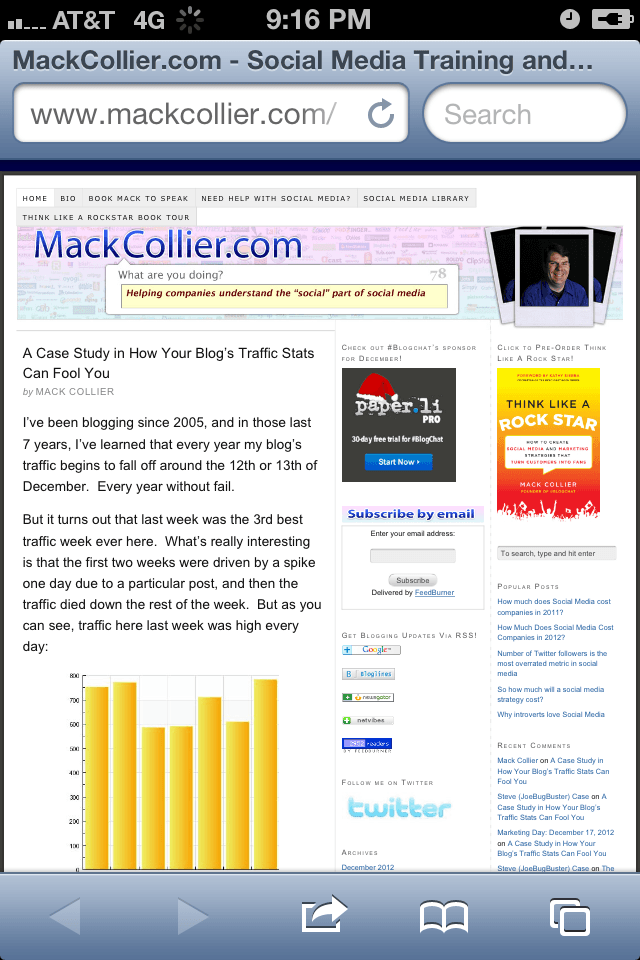
Then earlier this month I saw someone mention WPTouch as a plugin that optimizes your blog for viewing on smartphones, and I decided to check it out.  First, here's what this blog looked like on my iPhone before I added the plugin:

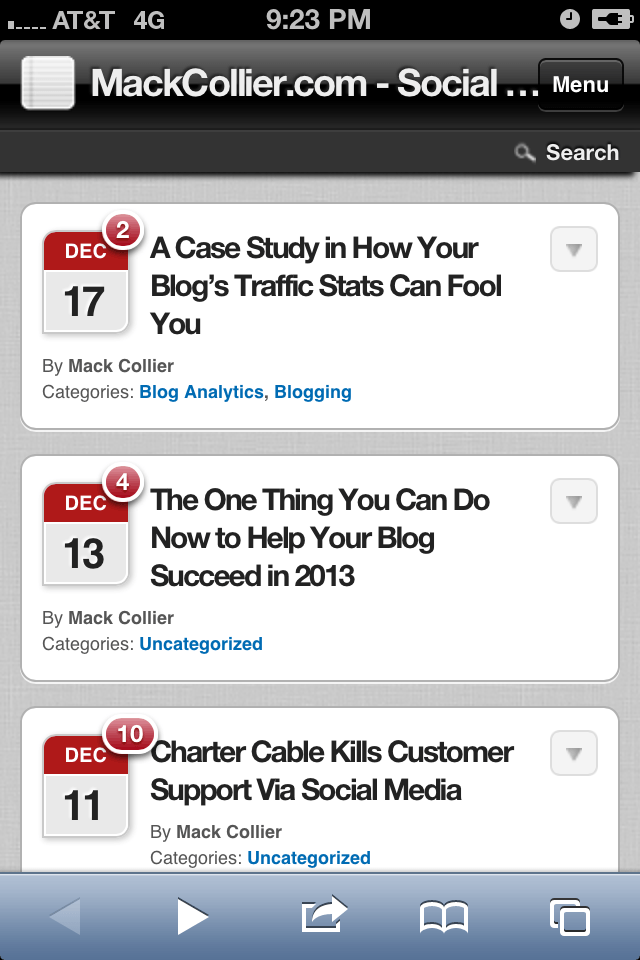
Yeah you're not reading that without some serious pinchin' & zoomin.  So I went and installed the WPTouch plugin, and less than a minute later, here's what the blog looked like on my iPhone:

MUCH better!  Now you clearly see the headline, date, plus number of comments!  Same content, but it's been optimized to improve viewing on a mobile device.  I went in and changed it to show the full post title and this is what that looked like:

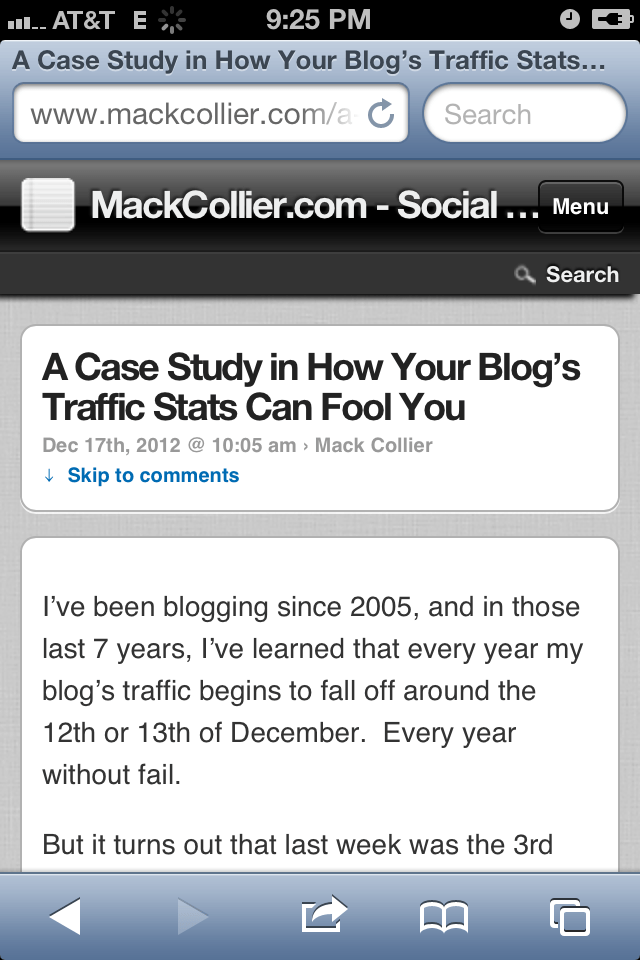
I like that a bit better!  And if you click on one of the posts, here's what it looks like on your iPhone:

So much prettier than before!  If you want to add WPTouch to your own WordPress blog and make it mobile, it could NOT be easier:

1 – Log into your WordPress dashboard.

2 – Click on Plugins

3 – Search for WPTouch

4 – Install it

5 – Activate it

You're done!  60 seconds, tops, you can probably do it in closer to 30 seconds.  Then you can go in and edit some of the features as I did.  It will be interesting to see if my mobile traffic, especially from iPhones, increases any.  See, you get the best tips and tricks at #Blogchat ;)

How to Make Your WordPress Blog Mobile-Friendly In Less Than 60 Seconds by Mack Collier Oh how I love quick and easy solutions! I’ve been meaning to make a mobile-friendly version of this blog for a while now, and it just stayed buried on my To-Do list. Then a couple of weeks ago I was out and I checked Facebook on my iPhone and someone linked to a post that Peter Shankman wrote. I pulled it up on my iPhone and what I loved was the site was optimized for a smartphone! It just served up the post, not the entire site, so it was much easier to read on my iPhone! Then earlier this month I saw someone mention WPTouch as a plugin that optimizes your blog for viewing on smartphones, and I decided to check it out. First, here’s what this blog looked like on my iPhone before I added the plugin: Yeah you’re not reading that without some serious pinchin’ & zoomin. So I went and installed the WPTouch plugin, and less than a minute later, here’s what the blog looked like on my iPhone: MUCH better

By Ehijoshua (Jboss) → Wednesday, 15 October 2014

Five Simple Ways to Lower Your Blood Sugar

Clay Wirestone

| Apr 4, 2013

Diabetes can seem complicated and overwhelming, full of charts and devices and concerned-looking medical professionals. There's talk of hormones and endocrine systems, of obscure organizations and dietary plans.

It all comes down to this: What it's really about-the one, single thing it's about-is lowering that sky-high blood sugar number.

That's it. Everything follows from getting that blood sugar number down. It doesn't matter how you got there, and it doesn't matter what you did. What's important, what's critical for you right here, right now, is to lower that number.

Here are five simple ways to lower your blood sugar. The list doesn't including the most obvious choices (medication) because you know them already. These are some methods you might not have thought about.


1. Stay on your feet

The simple answer that doctors give diabetics (especially type 2s) who want lower their blood sugars is to exercise. And it works!

But what if you're not the exercising type? What if the sight of a treadmill or exercise bike or running shoes gives you the fits? That's okay, too, actually. You might want to consider simply  spending a chunk of each day on your feet. According to the U.S. Department of Health and Human Services, simple activities like sweeping the floor or dusting the shelves or taking the dog out for a walk are all healthy ways to stay active. You will burn calories, and you will move that blood sugar number down.

2. Drink water

Believe it or not, evidence suggests that staying hydrated can have an effect on blood sugars and whether or not people develop type 2 diabetes. Is the effect it a big one? We're not sure yet. But a 3,000-person study cited in the New York Times showed that people who drank the most water-17  to 34 ounces a day-were 30 percent less likely to develop diabetes than those who drank less water.

Further research cited by the Times shows when your body is dehydrated, your kidneys go into panic mode. They retain water and release a hormone that raises blood sugar. So make sure to keep that water glass filled up. You're reducing your chance of developing high blood sugars and possibly cutting long-term health risks!

3. Reduce stress

Anybody with type 1 diabetes will tell you that if you have a spike in your stress level, your blood sugar level will likely spike, too. But this advice works for type 2s and nondiabetics as well. As the American Diabetes Association puts it, stress causes your body to react aggressively. Glucose is dumped into your blood, giving you a source of quick energy.

But this doesn't work for people with diabetes. Without the insulin to convert that sugar into a form your body can use, it simply piles up. And it causes-you guessed it-high blood sugars. Before you freak out, then, step back. Take a few seconds to settle down. Perhaps you could try some breathing exercises or meditation. Whatever you do, keeping yourself tranquil will help keep those blood sugar levels level.

4. Watch your weight

Diabetic hear certain bits of advice all the time. We've already covered the exercise one. Well, here comes another: Watch what you weigh. The bigger you are, the more challenges you're likely to have with your blood sugars. For type 2s, weight is one of the main risk factors for developing the disease. Your body struggles to keep up with the bigger (and heavier) demands placed on it.

But no one says you have to lose hundreds of pounds at once. Yo-yo dieting can cause problems of its own. But you should know your weight, if you're too heavy, you should work to lose some of those pounds. And according to the National Heart, Lung and Blood Institute, weight loss is good for a bunch of other things, too. It can lower your blood pressure (another major problem for many people with diabetes) and decrease your bad cholesterol.

5. Snack smarter

You already know that certain snacks won't help your blood sugar levels. Candy bars and other sugary treats can send your blood glucose levels spiraling out of control. But that doesn't mean you can't snack at all.

Many kinds of vegetables-celery and broccoli for instance-have few carbohydrates and won't raise your blood sugar very much. Certain kinds of fruits, mainly berries, have few carbs and a low glycemic index, which means that whatever kind of sugar they contain is absorbed into your body slowly.

And that's just a start. There are a multitude of diabetic-friendly ways to snack. Eggs, olives, and string cheese all have small amounts of carbohydrate. Plentiful information on such snacks is available at the Diabetes Health website (diabeteshealth.com), and the sites of organizations like the ADA and the Mayo Clinic have valuable information and tips as well. Whatever kind of snack you pick, make sure it's something that contributes to your health goals.

Final note

Let's close with a word of warning. These suggestions should not replace insulin or any other diabetic drugs prescribed by your doctor. As a person with diabetes, you need a team of health-care professionals and an overall treatment plan. Type 1s will need to take medication for the rest of their lives (or until the arrival of a cure). Many type 2s will need medication as well.

While there are many practical, simple ways to keep your blood sugar down (or keep it from going higher), never turn your back on solid, scientifically proven treatments. You deserve the best care possible.

- See more at: http://diabeteshealth.com/read/2013/04/04/7830/five-simple-ways-to-lower-your-blood-sugar/#sthash.JNoBOrjz.dpuf

Five Simple Ways to Lower Your Blood Sugar

By Ehijoshua (Jboss) → Tuesday, 14 October 2014

10 Things You Don't Know About Sugar (And What You Don't Know Could Hurt You)


Excessive sugar in the diet is not the best idea when it comes to healthy living. Nonetheless, few of us are consuming sugar in recommended moderate amounts and most of us are eating tons of it. In fact, worldwide we are consuming about 500 extra calories a day from sugar. That's just about what you would need to consume if you wanted to gain a pound a week. Most people know that sugar is not good for them, but for some reason, they think the risk of excess sugar consumption is less than that of having too much saturated and trans fat, sodium or calories. Perhaps it's sugar's lack of sodium or fat that make it the "lesser of several evils," or perhaps people are simply of the mind frame that what they don't know won't hurt them. If you really knew what it was doing to your body, though, you might just put it at the top of your "foods to avoid" list. Here are ten things that may surprise you about sugar.

1. Sugar can damage your heart
While it's been widely noted that excess sugar can increase the overall risk for heart disease, a 2013 study in the Journal of the American Heart Association displayed strong evidence that sugar can actually affect the pumping mechanism of your heart and could increase the risk for heart failure. The findings specifically pinpointed a molecule from sugar (as well as from starch) called glucose metabolite glucose 6-phosphate (G6P) that was responsible for the changes in the muscle protein of the heart. These changes could eventually lead to heart failure. Approximately half of the people that are diagnosed with heart failure die within five years.

2. Sugar specifically promotes belly fat
Adolescent obesity rates have tripled in the past 30 years and childhood obesity rates have doubled. Many of us are aware of the data that demonstrates just how literally big our future is looking, but beyond the studies and all the initiatives to curb childhood obesity, one needs only to visit an amusement park, school or mall to truly see what is happening. One factor that seems to inflict obese children is fat accumulation in the trunk area of the body. Why? One cause may be the increase in fructose-laden beverages. A 2010 study in children found that excess fructose intake (but not glucose intake) actually caused visceral fat cells to mature -- setting the stage for a big belly and even bigger future risk for heart disease and diabetes.

3. Sugar is the true silent killer
Move over salt and hypertension, you've got competition. Sugar, as it turns out, is just as much of a silent killer. A 2008 study found that excess fructose consumption was linked to an increase in a condition called leptin resistance. Leptin is a hormone that tells you when you've had enough food. The problem is, we often ignore the signal our brain sends to us. For some people though, leptin simply does not want to work, leaving the person with no signal whatsoever that the body has enough food to function. This in turn can lead to over consumption of food and consequently, obesity. Why the silent killer? Because it all happens without symptoms or warning bells. If you've gained weight in the past year and can't quite figure out why, perhaps you should look at how much fructose you're feeding your body.

4. Sugar may be linked to cancer production and may effect cancer survival
In the world of nutrition, it's hard to talk about sugar without talking about insulin. That's because insulin is sugar's little chaperone to the cells, and when too much of it is consumed, or our insulin does not work (probably because we're eating too much sugar) and the body revolts. One connection that has been well documented in the literature is the link between insulin resistance and cancer . A 2013 study found that sugars in the intestine triggered the formation of a hormone called GIP (controlled by a protein called β-catenin that is completely dependant on sugar levels), that in turn, increases insulin released by the pancreas. Researchers found that β-catenin may in fact affect the cells susceptibility to cancer formation. Further studies have found negative associations between high sugar and starch intake and survival rates in both breast cancer patients and colon cancer patients.

5. Your sugar "addiction" may be genetic
If you've ever said, "I'm completely addicted to sugar," you may actually be correct. A recent study of 579 individuals showed that those who had genetic changes in a hormone called ghrelin consumed more sugar (and alcohol) than those that had no gene variation. Ghrelin is a hormone that tells the brain you're hungry. Researchers think that the genetic components that effect your ghrelin release may have a lot to do with whether or not you seek to enhance a neurological reward system through your sweet tooth. Findings with this study were similar to study conducted in 2012 as well.

6. Sugar and alcohol have similar toxic liver effects on the body
A 2012 paper in the journal Nature, brought forth the idea that limitations and warnings should be placed on sugar similar to warnings we see on alcohol. The authors showed evidence that fructose and glucose in excess can have a toxic effect on the liver as the metabolism of ethanol -- the alcohol contained in alcoholic beverages had similarities to the metabolic pathways that fructose took. Further, sugar increased the risk for several of the same chronic conditions that alcohol was responsible for. Finally, if you think that your slim stature keeps you immune from fructose causing liver damage, think again. A 2013 study found that liver damage could occur even without excess calories or weight gain.

7. Sugar may sap your brain power
When I think back on my childhood, I remember consuming more sugar than I probably should have. I should have enjoyed my youth back then, because unfortunately, all the sugar may have accelerated the aging process. A 2009 study found a positive relationship between glucose consumption and the aging of our cells. Aging of the cells consequently can be the cause of something as simple as wrinkles to something as dire as chronic disease. But there is other alarming evidence that sugar may affect the aging of your brain as well. A 2012 study found that excess sugar consumption was linked to deficiencies in memory and overall cognitive health. A 2009 study in rats showed similar findings.

8. Sugar hides in many everyday "non-sugar" foods
While many of my patients strive to avoid the "normal" sugary culprits (candy, cookies, cake, etc.), they often are duped when they discover some of their favorite foods also contain lots of sugar. Examples include tomato sauce, fat free dressing, tonic water, marinates, crackers and even bread.

9. An overload of sugar (specifically in beverages) may shorten your life
A 2013 study estimated that 180,000 deaths worldwide may be attributed to sweetened beverage consumption. The United States alone accounted for 25,000 deaths in 2010. The authors summarize that deaths occurred due to the association with sugar-sweetened beverages and chronic disease risk such as diabetes, heart disease and cancer.

10. Sugar is making us fat
I figured I'd leave the most obvious fact for last. While you may be aware that too many calories from any source will be stored as fat if not burned, what you may not connect is that the lack of other nutrients in sugar actually makes it much easier to eat gobs of it with no physical effects to warn us of the danger that lurks. Foods rich in fiber, fat and protein all have been associated with increased fullness. Sugar will give you the calories, but not the feeling that you've had enough. That's why you can have an entire king-size bag of licorice (with it's sky high glycemic index at the movies and come out afterwards ready to go for dinner.

On a final note, it's important to point out that simple sugars from milk (in the form of lactose) don't display the same negative health effects that we see in the literature when reviewing sugar's effects on the body. Simple sugars coming from fruit are also less concerning given their high amounts of disease-fighting compounds and fiber.

So now you know, and knowing perhaps can create action. You can do something about decreasing your overall sugar consumption without feeling deprivation or sheer frustration! That will be the focus of my next blog. Stay tuned!

10 Things You Don't Know About Sugar (And What You Don't Know Could Hurt You)

By Ehijoshua (Jboss) →

Women at the top struggle for funding


business women

When the recession hit, Jena Gardner was worried. Her business focused on luxury travel destinations in the U.S., and that sector was getting hit especially hard.

"During the recession, it was hard times. I put some of my own personal capital into the company, which I have not paid myself back with," she said. "I invested when I think a lot of people were hunkering down."

Gardner invested about $200,000 of her own money, and saw many existing options, like a line of credit at the bank, dry up with the recession.

"Access to capital is really hard for women-owned businesses," she said.

She's right. A study released Wednesday by the Women Presidents' Organization, a nonprofit for high-level women entrepreneurs, showed that 33% of women reported using their own money to start their businesses, with less than 1% saying they received venture capital or angel investing.

Access to capital is one of the biggest differences between men and women in business. A 2012 study by the National Women's Business Council found that, on average, men start their businesses with nearly twice as much capital as women, and women receive only 2% of their total funding from outside sources, compared to 18% for men.

"The networks that are established by their male counterparts don't always include the opportunity for women to participate," said Dr. Marsha Firestone, founder of the WPO. "I don't say that in terms of being critical of men. That's just the way the networks work."

Wall Street still hires mostly white men

But, she said, women are still starting businesses en masse. "It's amazing to me that they're able to find their way around the roadblocks in the marketplace and start their businesses."

One member of the WPO, June Ressler, started her company in her kitchen in 1996 with her own savings of $75,000.

"I wasn't thinking much about investors," she said. "I didn't think it was going to amount to much."

Last year, her business was named one of the top 50 fastest-growing women-owned companies in America by the Women Presidents' Organization.

Her business, Cenergy International Services, which provides logistical support for the oil and gas industry, was recently ranked the largest women-owned business in Houston, with 147 local employees and local revenue of $260 million.

"I'm definitely confident moving forward in the future," Ressler said. "The energy industry is really hot."

Women have trouble asking for money -- and their businesses suffer

Her optimism is shared by the survey respondents.

"Last year, maybe 50% of our members were uncomfortable with the direction of the economy," said Firestone. Now, only 7.6% see economic conditions as a threat to their bottom line. Nearly half said they'd added employees, and more than of quarter of their businesses have grown by 25% or more in 2014.

"There's been an unbelievable change for the better and we're very pleased about that," Firestone said.

Women at the top struggle for funding

By Ehijoshua (Jboss) → Sunday, 12 October 2014

Retirement: Virtues of the 401(k)

Uncle Sam doesn't offer many gifts. This is one.The upside: free money


In Lesson 13


Money Essentials Lessons

If someone offered you free money, would you refuse it? Probably not. But that's just what you're doing if you don't contribute to your 401(k).

The more you contribute, the more free money you get. Here's why.

Contributing part of your salary to a 401(k) gives you three compelling benefits:

- You get an immediate tax break, because contributions come out of your paycheck before taxes are withheld, thereby lowering your taxable income.

- The possibility of a matching contribution from your employer -- most commonly 50 cents on the dollar for the first 6% you save, according to Towers Watson.

- You get tax-deferred growth -- meaning you don't pay taxes each year on capital gains, dividends, and other distributions

Thanks to the Tax Relief Reconciliation Act of 2001, there are a few changes to 401(k)s that may be of even greater benefit to you.

For starters, the federal limit on annual contributions is set at $17,500 for the 2013 tax year.

The Tax Relief Act also offers catch-up provisions for workers 50 and older. That is, those 50 and older now may contribute an additional amount, now set at $5,500, above the maximum allowable 401(k) contribution.

Keep in mind, however, while federal law sets the guidelines for what's permissible in 401(k) plans, your employer may set tighter restrictions. Plus, it may take time for the administrators of your plan to implement the changes.

What's more, there are other federal non-discrimination tests a 401(k) plan must meet, one of which applies to "highly compensated" employees. So if you make more than $115,000 in 2013, you may not be permitted to contribute as high a percentage of your salary as some of your lower paid colleagues.

For all its tax advantages, the 401(k) is not a penalty-free ride. Pull out money from your account before age 59-1/2, and with few exceptions, you'll owe income taxes on the amount withdrawn plus an additional 10% penalty.

Also, be aware of your plan's vesting schedule -- the time you're required to be at the company before you're allowed to walk away with 100% of your employer matches. Of course, any money you contribute to a 401(k) is yours.

Retirement: Virtues of the 401(k) Uncle Sam doesn't offer many gifts. This is one.The upside: free money

By Ehijoshua (Jboss) →

How should I invest for retirement?


In Lesson 13


Your retirement savings are sacred, so you don't want to take crazy risks. That doesn't mean you should rely solely on safe investments such as bank CDs and money-market funds.

To build a nest egg large enough to see you through retirement, which may last 30 years or more, you'll need the growth that stocks provide.

Since 1926, stocks -- broadly speaking, using the S&P 500 index as a measure -- have posted an average annual return of nearly 10%, versus little more than 5% for bonds, according to Ibbotson Associates.

Given stocks' superior long-term returns, some financial advisers recommend that investors whose retirement is still 20 years or more away put the lion's share of their portfolio in stocks and stock funds.

Of course, a 100% stock portfolio can give you some hair-raising moments (or years). In the 1973-74 bear market, for example, U.S. stocks lost 43% of their value and took three-and-a-half years just to get back to where they started.

Moreover, those whose stock portfolios are concentrated may suffer even more dramatic ups and downs.

If you don't have the stomach for steep downturns, a more prudent course is to throw some bonds into the mix. Putting 70% of your portfolio into stocks and 30% into bonds, for example, will let you capture most of the long-term growth of stocks while sheltering your investments somewhat during meltdowns.

As you approach retirement age, the idea is to shift more into bonds. But even in retirement, which can last a few decades, it pays to maintain a healthy dose of stocks (maybe upwards of 50% in your 70s, and up to 30% in your 80s).

Take care, however, to understand the kind of companies you're investing in. More volatile stocks may not be appropriate for you at this stage in your life.

For help on finding the right allocation for you, try CNNMoney's Asset Allocation Tool.

How should I invest for retirement?

By Ehijoshua (Jboss) →

First steps for retirement planning

The path to a successful retirement starts with creating an overall plan.


To live well in retirement, you no longer can rely solely on a company pension plan or Social Security. Instead, you will have to depend on how skillfully you plan and invest, and whether you make good use of tax-advantaged savings plans such as 401(k)s and IRAs.

First, estimate how much you will need. One rule of thumb is that you'll need 70% of your annual pre-retirement income to live comfortably. That might be enough if you've paid off your mortgage and are in excellent health when you kiss the office goodbye.

But if you plan to build your dream house, trot around the globe, or get that Ph.D. in philosophy you've always wanted, you may need 100% of your income or more.

Remember, too, that your health care expenses are likely to go up in retirement, if only because you'll be paying more for insurance, especially if you retired prior to being eligible for Medicare, says Gordon Homes, senior financial planner at MetLife. Some employees who retire before 62 don't realize how much their employers contribute to health care, Homes says, which has led some to consider retiring after 65.

Second, figure out how you'll meet those expenses. There are three main sources of retirement income: Social Security, pensions and annuities, and your savings. Start by determining your estimated Social Security benefits. (If you haven't already received a statement in the mail, you can order one online or use an online calculator to make estimates based on expected earnings.)

Next, add in any annual payouts you expect from an annuity or company pension.

If it's not enough, it's time to think about where that money will come from. Count on needing at least $15 to $20 in investment savings to cover each dollar of that shortfall. If your projected retirement expenses exceed Social Security and pensions by, say, $20,000 a year, that means you'll need a nest egg of $300,000 to $400,000 to bridge the gap.

CNN/Money's Retirement Savings Planner can help you come up with an estimate of how large a nest egg you'll need. And our asset allocation tool will help you find the right mix of stocks and bonds to help you build it.

First steps for retirement planning The path to a successful retirement starts with creating an overall plan.

By Ehijoshua (Jboss) →